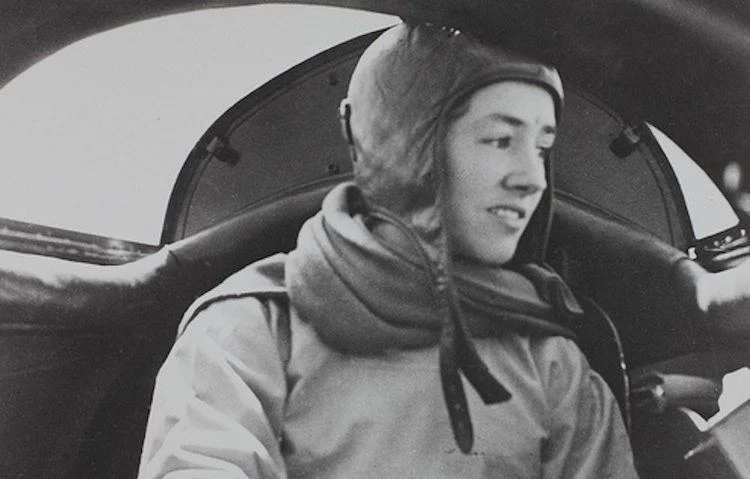
Anne Morrow Lindbergh (1906-2001) was initially famous through her marriage to Charles Lindbergh in 1929–but she had her own career as a pilot. In 1930, she became the first US woman to earn a 1st Class Glider Pilot’s license (requiring five minutes’ flight above the shock-cord launch release altitude). She served as navigator that same year, while seven months pregnant, when her husband set a new transcontinental speed record.
In 1931, she earned her Private Pilot-Airplane license. Perhaps the most famous flight the Lindberghs made together was the 1931 Great Circle survey through Northern Canada, Alaska, and the Far East, described so eloquently in Anne’s book North to the Orient. Anne served as a copilot and radio operator in the Lockheed Sirius, now displayed in the Smithsonian National Air and Space Museum’s Pioneers of Flight gallery. The Sirius was also used for the Lindberghs’ 1933 North Atlantic Ocean survey flight for possible commercial air routes for Pan American Airways. In 1934, she became the first woman to receive the National Geographic Society’s Hubbard Gold Medal, awarded for more than 40,000 miles of exploration across five continents.
Anne Lindbergh also received the U.S. Flag Association Cross of Honor (1933). She was later inducted into the National Aviation Hall of Fame (1979) and the International Women in Aviation Hall of Fame (1999).
Lindbergh established herself as a distinguished author of non-fiction, fiction, and poetry. In addition to North to the Orient (1935), she wrote Listen! The Wind (1938), The Steep Ascent (1944), Gift from the Sea (1955), The Unicorn and Other Poems (1956), and Dearly Beloved (1962). She was a dedicated diarist and letter writer; she also published six collections of her diary entries and letters, starting with Bring Me a Unicorn (1971).