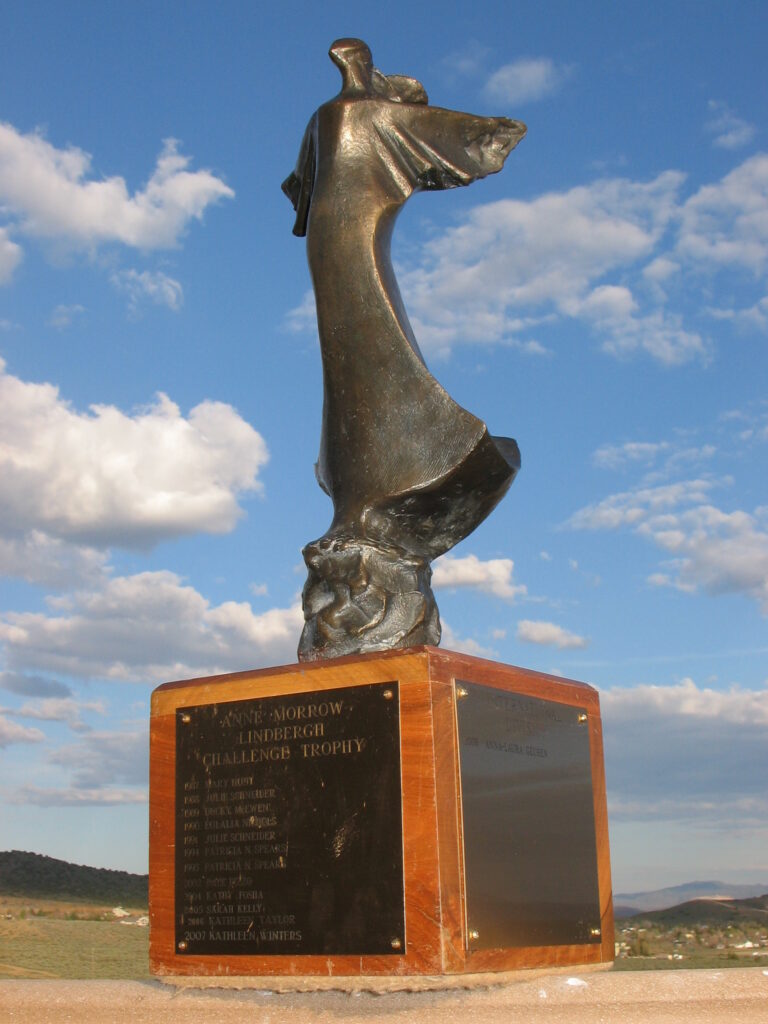
The Anne Morrow Lindbergh (AML) Challenge Trophy recognizes a WSPA member with the longest handicapped non-contest cross-country flight of the year. The pilot handicap encourages new pilots to attempt cross-country flights while the sailplane handicap puts low-performance, low-cost gliders on the same level as high-performance gliders. The contest runs from March 1 through the last day in February of each calendar year.
The trophy is named for Anne Morrow Lindbergh, who in 1930 became the first woman in the United States to get a First Class Glider Pilot’s license. She went on to achieve many additional aviation firsts in partnership with her husband Charles Lindbergh as navigator.
The AML Challenge Trophy is now permanently displayed at the National Soaring Museum at Harris Hill, Elmira, New York.
Past AML Challenge Trophy Winners
| 1987 – Mary Hunt Rust | 1988 – Julie Schneider | 1989 – Ducky McEwen |
| 1990 – Eulalia Nichols | 1991 – Julie Schneider | 1994 – Pat N. Spears (D) |
| 1995 – Pat N. Spears (D) | 2002 – Dale Pizzo | 2004 – Kathy Fosha |
| 2005 – Sarah Kelly | 2006 – Kathy Taylor (D) | 2007 – Kathleen Winter |
| 2008 – AnnaLaura Geusen, DE | 2010 – Carol Mulder, CDN | 2013 – Elke Fuglsang-Petersen |
| 2020 – CarolAnn Garratt | 2022 – Kathy Fosha | 2023 – Cathy Keller |
| 2024 – Kristin Ann Farry | 2025 – Jenna Cooper | 2026 – Adriana Barragan, MEX |
WSPA Anne Morrow Lindbergh Challenge Trophy Rules
(Last Update: 2023)
- Contestant Eligibility: The AML contest is open to all full members of the WSPA. Both student and fully licensed women pilots may enter
- Contest Duration: The contest runs from March 1st through the last day in February of any given calendar year.
- Entry Procedure: All Claims must be submitted using the AML Trophy Fight Claim/Application Form along with an FAI-approved IGC flight record (except for straight-out flights — see item 8 below). Submit only an unaltered FAI IGC file. If a glider with a motor is used, the IGC record must include an Environmental Noise Level (ENL) sensor or a motor current sensor (electric sustainers too quiet for ENL detection). If the motor glider is aero-towed (in the case the motor is only a sustainer) and the flight recorder is only equipped with an ENL sensor, the pilot must start and run the motor for two minutes within five minutes of aerotow release to establish the motor noise recording capability of the IGC recording.
- Entry Deadline: All entries must be submitted by April 30th after the contest year end to: trophy@womensoaring.org.
- Flight Recorders: Any Global Navigation Satellite System (GNSS) Flight Recorder approved by the FAI for badge flights may be used. Other flight recorders may be used as long as they output an IGC-type file compatible with Naviter SeeYou© for analysis. A five-second data recording interval is adequate.
- Flight Constraints:
- Only solo flights qualify.
- Badge flights qualify.
- Contest flights do not qualify.
- Flight Path: The entrant selects the task to be flown.
- A turn point may only be used once for goal-and-returns, triangles, quadrilaterals or zigzags.*
- Straight-out distance flights qualify.
- Observer: The observer (witness) must be unrelated to the pilot. For flights that begin and end at the same place, the observer must put the IGC recorder into the glider and remove it from the glider after the flight. If the flight is a straight-out distance flight where only the distance between the release and the landing is claimed, then the tow pilot and landing site witness are adequate to confirm the flight with or without an IGC log. If an IGC log is used to confirm a straight-out distance flight where tow pilot and landing observers are also used to confirm the flight, the observer need not install and remove the IGC recorder.
- Handicapped Distance: Raw cross-county statute mileage will be multiplied by pilot and sailplane handicap. Statute mileage will be converted to kilometers in the calculation for compatibility with FAI rules. The entrant’s estimates will be validated by the judges and may be adjusted to allow use of a common judging criteria.
- Sailplane Handicap: The sailplane handicap is selected from the latest SSA handicap list available at Soaring Society of America – Member Resources (ssa.org) for the sailplane make and model. Entrants must be specific on the sailplane information, specifying enough data on the sailplane to ensure that only one handicap applies.
- Pilot Handicap:
- If the pilot participates in the SSA Soaring Badge Program, the pilot handicap will be determined by the badge standing at the beginning of the year (March 1st). Completion of a badge during the trophy claiming flight will not alter the status at the start of the flight.
- Diamond Badge = 1.0
- Gold Badge = 1.5
- Sliver Badge = 2.0
- All Others = 2.5
- If the pilot does not participate in the SSA Badge Program, the pilot handicap will be determined by the pilot’s longest flight prior to the opening date of the current AML trophy period (March 1st of the prior year). Any pilot not participating in the SSA Badge program must provide their longest flight distance for the prior year or refer the judges to applicable onlinecontest.org (OLC) records.
- 500-km or greater = 1.0
- 300-km but less than 500-km = 1.5
- 50-km but less than 300-km = 2.0
- All Others = 2.5
- If the pilot participates in the SSA Soaring Badge Program, the pilot handicap will be determined by the badge standing at the beginning of the year (March 1st). Completion of a badge during the trophy claiming flight will not alter the status at the start of the flight.
- Judging: The year’s winner will be chosen by the AML Trophy Committee, using Naviter SeeYou distance calculated from the submitted FAI IGC file. Prior-year AML winners will be welcome to assist judging for the following year.
* If your flight does reuse a turnpoint, we will count the distance up to the reused turn point as your total distance, so please submit the flight anyway.